Soft washing a roof versus pressure washing it
The black streaks are living. Blasting them off takes the roof's protection with them.
September 17, 2026 · 3 min read
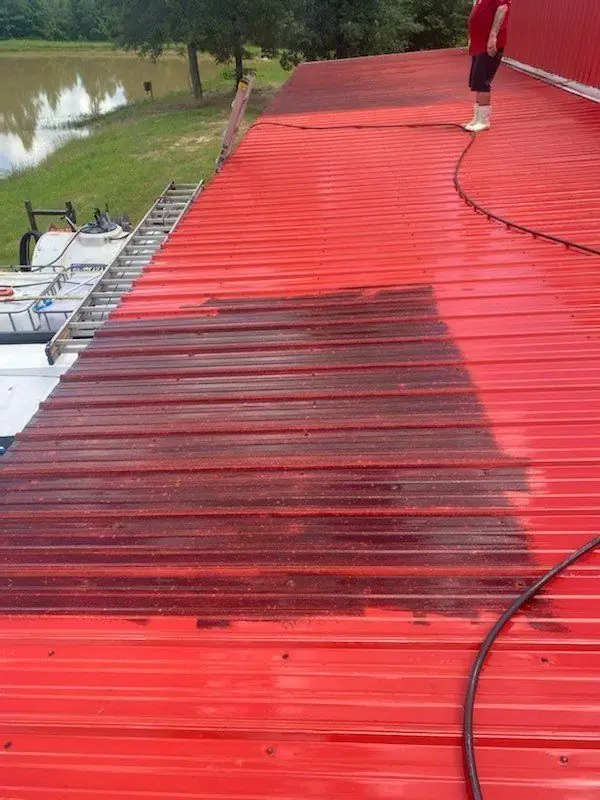
The dark streaks running down a roof in Northeast Louisiana are almost always the same thing: a blue green algae that feeds on the limestone filler in asphalt shingles. It is alive, it spreads, and it is why the streaking usually starts on the north facing slope and the shaded sections first. It is not dirt, and that matters, because dirt comes off with force and algae does not.
What pressure does to a roof
An asphalt shingle is a mat saturated with asphalt and then covered in ceramic coated granules. Those granules are the roof's sunscreen. They take the ultraviolet hit so the asphalt underneath does not dry out and crack, and they are what gives the shingle its colour and its fire rating.
They are also held on by the asphalt itself, which softens in heat. Put a pressure washer on a shingle roof on a hot afternoon and granules come off in quantity. You can see them in the gutters and at the bottom of the downspouts afterwards. The roof looks dramatically better that day and has had years taken off its life, because the asphalt underneath is now exposed in the places where the granule bed thinned out.
On a metal roof the failure is different but still real. Pressure driven up under the panel laps pushes water where the roof was designed to shed it, and aggressive work can dull or scar a coated finish.
What soft washing does instead
Soft washing applies cleaning solution at low pressure, lets it do the work of killing the organism, and then rinses gently. The pressure involved is closer to a garden hose than to a pressure washer. Because the algae is killed rather than blasted, it does not simply regrow from what was left behind, and the result lasts considerably longer than a mechanical clean does.
It is slower, and it looks less impressive while it is happening, which is precisely why some outfits do not offer it. There is no satisfying stripe appearing under the wand. The roof simply gets steadily cleaner over the following days as the dead growth washes off.
Where pressure is the right answer
None of this means pressure is bad. It is the correct tool for a lot of surfaces, and hot water pressure in particular is what actually removes grease, gum and ground in traffic film rather than moving it around. It belongs on concrete, on driveways and sidewalks, on dumpster pads and drive throughs, and on most hard exterior surfaces where there is no coating to protect.
- Concrete driveways, sidewalks and patios: pressure, and hot water makes a visible difference on oil and grease.
- Vinyl, aluminium and wood siding: low pressure with the right solution, because forcing water up behind siding is how you end up with a moisture problem inside the wall.
- Decks and fences: gentle, because wood fibres tear and a furred deck board never looks right again.
- Roofs, asphalt or metal: soft wash, always.
- Stucco, older brick and stone: gentle, because the mortar is usually softer than the masonry around it.
Ask two questions before anyone starts
The first is what pressure they intend to use on your specific surface, and the answer should be different for the roof than for the driveway. If it is the same answer for everything, that is the whole review right there.
The second is where the runoff goes. Cleaning solution running off a roof lands on whatever is below it, which in most yards here is planting, grass, or a slope down toward a bayou. Biodegradable and environmentally safe products exist and work, and using them is a choice the contractor makes before they arrive, not something you can fix afterwards.
How often a roof needs it
Far less often than a driveway. A roof that has been properly soft washed and had the algae killed rather than knocked off will usually go several years before the streaking returns, and how long depends mostly on shade. A slope that sits under trees and stays damp will come back sooner than one that gets direct sun and dries quickly after rain.
Trimming back the branches that overhang a roof does more for the problem than any cleaning schedule, because it removes both the shade and the constant supply of organic debris sitting in the valleys feeding the growth.
We run hot water, we soft wash roofs, and we use biodegradable product. Free estimates and free demonstrations are available, so you can see a test patch on your own wall before committing to the whole elevation.
David's Mobile Detail & Wash, (318) 547-3233
Call (318) 547-3233More articles
What a full detail actually includes, and what it does not
Detailing prices vary wildly because the word covers five different jobs. Here is what each level really involves.
Why a boat cannot be buffed like a car
Chalky hull, dull gelcoat, black streaks along the trim. What is actually happening, and what fixes it properly.